
I frequently get asked this question: How many solar panels do I need? In this post, I will share how to determine the number of solar panels needed for your house.
How many solar panels do I need?
The number of solar panels you need depends on the size of your home, how much electricity you use, and how much sunlight your roof gets.
Get your electricity consumption
You can determine your electricity consumption in two ways.
If you have a utility bill
If you pay the electric bill, you can see how much electricity you used; utility companies usually provide monthly and yearly usage.
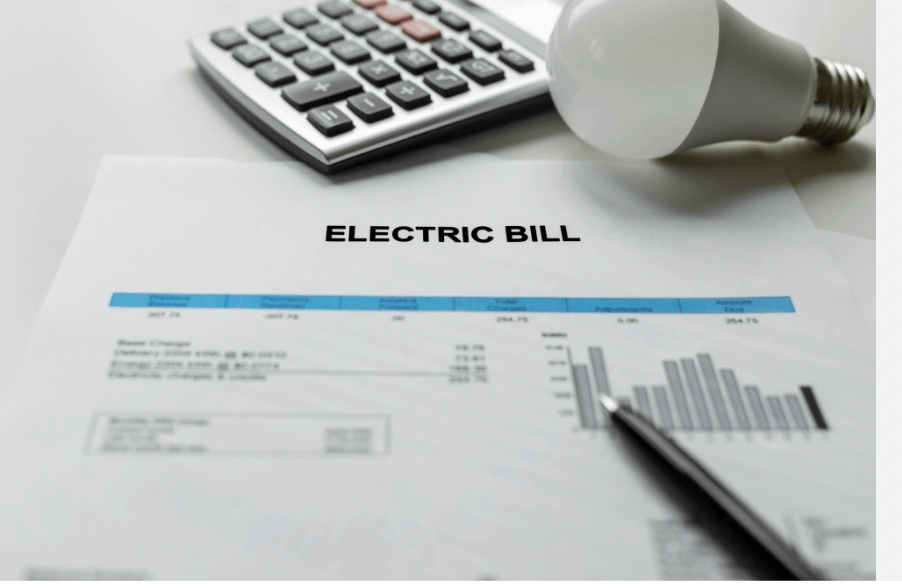
The power consumption is in KWh
If you do not have a utility bill
If you do not have a utility bill, finding the power consumption can be tricky. I ask the customer how many devices they plan to have and how many hours they plan to use them daily.
All electronic devices list how much power consumption (in Watts) is for the specific unit; what I will do is multiply the power consumption by the estimated time they are expecting to use it and then divide by 1000 to get the estimated KWh.
For example, if they have 3 laptops and each laptop consumes 100 watts, each laptop will be on average 12 hours a day.
That will be 3X100X12/1000, which will give me 3.6 KWh per day.
I will do this for all devices and add them up; you can have this per day, per month, or per year.
For example, let’s assume that regardless of the method used, the power consumption totals 12,000 kWh per year.
Find out how many peak sunlight hours your area gets
Before I explain how to find out how many sunlight hours your area gets, allow me to explain two concepts.
Solar Irradiance
Solar irradiance is the amount of sunlight reaching the Earth’s surface, while peak sun hours are the hours when the sun’s intensity is the strongest.
Peak sun hour
A peak sun hour is defined as one hour in which the intensity of solar irradiance (sunlight) reaches an average of 1,000 watts (W) of energy per square meter (roughly 10.5 square feet).
To find out how many solar peak hours your area receives, you can use online tools like the National Renewable Energy Laboratory’s (NREL) PV Watts calculator, which allows you to input your location to access estimated solar radiation data based on your latitude and weather patterns.
You can also use dedicated solar radiation maps or consult a local weather station if you need more precise measurements, which typically involve using a specialized instrument called a pyranometer to directly measure solar irradiance.
Get access to the PV Watts calculator here.
Let’s say you are located in California, and on average, you get 5-6.1 peak hours a day.
That is about 1800 peak hours a year.
Divide your household consumption by peak hours
Now you know how much power you consume, either daily, monthly, or yearly. Take that amount and divide it by the number of peak hours you get in that interval.
In this example, I got 12000 kWh and 1800 peak hours, so this value would be 12000 kWh/1800 h, which gives us 6.67 kW.
Decide which solar panels you are going to use
There are many solar panels on the market; each one has its advantages and disadvantages.
You need to know the output of the solar panels you will use. In this example, we will use the 400-watt solar panel.
You will divide the system size by the solar panel output, which will be 6.67 kW/0.4 kW, which is 16.68 panels.
Read: Best solar panels for homes
Consider the power loss due to wires and inverters
Wires and inverters (or an inverter) will cause a power loss. This is because the efficiency of most inverters is between 95 and 97%, which means they will not convert all the electricity. You will have a power loss between 3 and 5%.
Furthermore, there is a power loss due to the wires. This is because all wires have a resistance, and they will consume some of that power.
So I will consider a total power loss to be about 20%, so I will have to add 20% to the number of solar panels.
So you multiply 16.68 panels by 1.2, which is 16.68 x 1.2 = 20.
So you will need about 20 solar panels to power this hypothetical house.
You can adjust any variable to suit your project and determine the number of solar panels you need.
FAQ: How many solar panels do I need?
How many solar panels does the average home need?
Most homes need between 15 and 25 solar panels to cover 100% of their electricity usage.
The exact number depends on your monthly energy consumption (kWh), panel wattage, roof space, and local sunlight hours. Homes with higher electricity use or lower sun exposure will need more panels.
How do I calculate how many solar panels I need?
To calculate how many solar panels you need, follow this simple formula:
Annual electricity usage (kWh) ÷ (Panel wattage × average sun hours × 365)
For example, if your home uses 10,000 kWh per year, you install 400-watt panels, and your area gets 5 peak sun hours per day, you would need around 14–16 panels, accounting for system losses.
How many solar panels do I need for a house that is 2,000 square feet?
The size of the house alone doesn’t determine the number of solar panels.
A 2,000-square-foot home usually needs 16 to 24 solar panels, but the amount of electricity the family uses is more important than the size of the home.
How many solar panels do I need per kWh?
On average, one 400-watt solar panel produces about 1.5–2 kWh per day, depending on sunlight.
As a rough estimate:
- 1,000 kWh/month → 18–22 panels
- 500 kWh/month → 9–11 panels
These numbers can vary based on location and system efficiency.
How many solar panels do I need to run my house off-grid?
An off-grid home usually needs more panels than a grid-tied system because you must also account for battery charging and backup capacity.
Most off-grid homes require 20–35 solar panels, plus a properly sized battery bank and inverter.
How many solar panels do I need with battery storage?
Adding batteries doesn’t change how many panels you need to power your home, but it can increase the total panel count if you want to store excess energy.
If you plan to run your home at night or during outages, you may need an additional 2 to 6 solar panels to ensure your batteries are fully charged.
How many solar panels can fit on my roof?
Most residential roofs can accommodate 15 to 30 standard solar panels, depending on the following factors:
- Roof size and shape
- Panel dimensions
- Tilt and orientation
- Obstructions like vents or chimneys
Each panel typically takes up 18–22 square feet.
Does panel wattage affect how many solar panels I need?
Yes. Higher-wattage panels produce more power, so you’ll need fewer panels.
For example:
- 300-watt panels → more panels required
- 400–450-watt panels → fewer panels required
Using higher-efficiency panels is ideal when roof space is limited.
Do I need more solar panels in cloudy or cold climates?
Cloudy regions generally require more panels to compensate for reduced sunlight.
However, cold weather actually improves solar panel efficiency, so temperature alone does not increase panel requirements.
Can I start with fewer solar panels and add more later?
Yes, most systems can be expanded later, as long as the inverter and electrical design allow for it.
I always recommend planning future expansion from the beginning to avoid costly upgrades later.
Read: adding solar panels to existing system.
Will solar panels cover 100% of my electricity needs?
Often, yes. A properly sized system can cover 100% or more of your electricity usage.
Some homeowners choose to offset only 70–90% of their usage to reduce upfront costs.
Is it better to oversize or undersize a solar system?
It’s usually better to slightly oversize your system if your utility allows net metering.
This helps cover future increases in energy use, such as EV charging, heat pumps, or additional appliances.
Takeaways: How many solar panels do I need?
The number of solar panels you need depends on the size of your home, how much electricity you use, and how much sunlight your roof receives.
I recommend contacting a professional installer who can assist you in determining the number of solar panels required for your house.
